
Birthright | Credit: Here
31.05.25
The beauty of age lies in wisdom. I have straddled different worlds, my heart still in Africa and my body safely on Australian soil. While I wish I could live in the kind of Australia the Indigenous Australians had envisioned for themselves, I honour the spirits of the land as they have treated me as one of their own. Straddling the Australia whose present is the manifestation of white aristocrats from England, I see now the power of Southern African divinity. There is spirit in the way that we walk, the way that we wait, the way we grieve and the way we love. The most confusing part for someone born and raised in the West, is our history is not always passed down through books. We have preserved our magic by passing on stories (oral tradition), and living the prayers of our forefathers.
I cannot remember a time when dreams were meaningless. For as long as I can remember dreams have always been a form of communication. Either within myself or a pathway for ancestors. We’ve never had to be told that nature was magic. We feel it in the fields that we till our crops. We feel it in the heat of the sun, the eerie feeling by the riverside and the chill that grips your bones when an owl turns its head in that diabolical way. We were taught to respect silence so much so that being out in nature, the moment everything quietens – we listen. We don’t whistle in the dead of night, lest we attract the wrong attention. It is common for people to make intuitive judgements and they do not have to be justified. That woman in town people avoid? There is a spirit of descent upon her, stay away from her.
The deference shown to the elders in our community taught us not to fear age. As a Southern African, I find the Western world to be incredibly ageist. When you have communities, that treat their elderly like inconveniences to be carted off and locked away, never to be remembered – it is incredibly jarring. When I see the grey hairs of my mother or my grandmother, I see earned insight. My first grey hair at 15 was a celebration as I could finally point to something that implicated my inner knowing as an old soul.
Speaking of old souls, we believe in reincarnation. Not in a showy way, or as a part of doctrine. We greet newborn babies with the same reverence we greet elders. The last Zimbabwean newborn I visited, I held her in my arms as she calmly played and listened to our conversations. She had that eerie calm that many of our children have. The calm that comes from having lived and not needing to prove yourself. In her eyes, I saw galaxies of knowledge. Her knowing was as valid as my own, even if her speech had not developed.
Cooking in Southern Africa is more than just making a meal. I can taste the love in a meal, and I can taste the hate. We tend not to eat from people we distrust or people we do not like. If we suspect anyone of nefarious intentions, their food will not touch our lips. In the event that we eat that food, when things start spiralling spiritually, we know who to trace it back to. We cook not only for ourselves but for our ancestors. It is not unusual to cook for them, through them and for them to cook through you. Important ceremonies involve eating and drinking as a form of communion with each other’s spirits and with the ancestors. We soothe, calm and love each other through feasting.
Spirit tells me that carrying water has always been a ceremony and we just forgot to name it that. Each step toward the river or the borehole is a prayer. The path itself offers a meditation. A communion with nature and the ancestors, an opportunity for spiritual knowledge to be absorbed. We tend to balance the water on our heads. We learn through balancing this water that we are capable of much. Not only for ourselves but for our community as well. Hardship is righteous when you do not resist it. Our hardships create a container of fortitude that we later use to better our community. Bringing water home to your family, after the labour of collection – is an act of devotion to life and spirit.
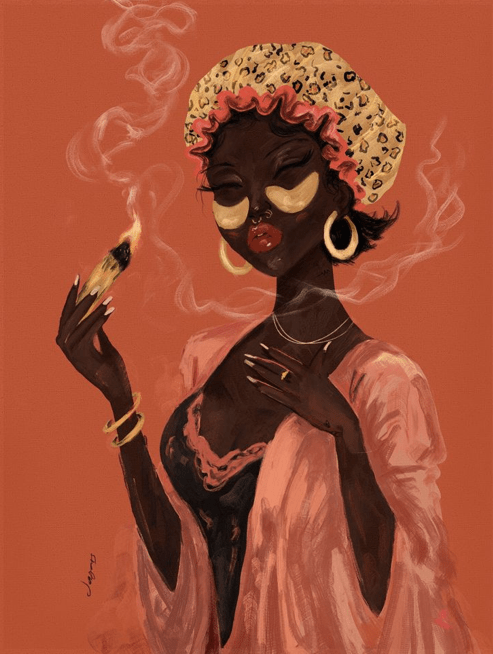
While for some beauty rituals are a simply an enjoyable pastime, for us our rituals are our connection to the divine. Not even in village life is cleanliness or beauty unimportant. In fact Westerners are sorely mistaken when they look down on villagers. There’s too much to discuss in this piece but you could never have the stamina and dignity of a villager, I will promise you that. Our mothers and grandmothers bathed us and oiled our skin. They showed us that taking care of our vessel was a show of gratitude. Our mothers taught us the beauty of structure through bathing rituals and adornment. They taught us to cover our crowns with scarves not to hide our hair but to protect our energy. They taught us to shake our hips and stomp our feet to channel, whether they used those words or not. That through joy, or pain we could dance for communion with the divine.
In Southern Africa we revere the land. The land is not an unfortunate consequence. We speak to the spirits of the land, of the water and of the dead. When we enter wilderness that we are unfamiliar or we enter sacred land, we ask for permission. We ask the elders or we ask the spirits themselves and wait for the signs. The signs could be a snake standing in your way, a snake knocking on the trunk of a tree (this happens) or an increasingly uneasy feeling the further you go. While it is normal for us to always feel watched, there are different levels and our bodies translate the language of the spirits.
We know not to speak ill of nature. When you encounter a tree in the middle of nowhere with strange fruit, you leave it. You do not touch it and you do not make disparaging remarks. We are taught not to speak ill of things that we do not understand lest we conjure them. I always tell people in earnest, if you ever come visit me in Zimbabwe, you keep your thoughts to yourself about your lack of belief in magic. Where we come from, speaking things out loud can conjure or be seen as a dare. And where we come from, spirits do not play. You want a lesson, then you run your mouth.
This is why our silence is wise. If you have read my other blog posts you will know that the first time I ever realised I had magic within me was by how I communed with the trees in my environment. The trees felt like my friends and my guardians all at once. I used them for divination, before I even understood what it was. Southern African divinity is intrinsic to our daily life. There is no function in our lives that needs to be separated from holiness. When we remember the truth of who we are and embrace it as I have, we can continue to use our inherited knowledge to further our community.
You may ask why you’ve never heard enough about the beauty and spirituality of Southern Africans. The answer is simple. You never asked. Whether it was through colonisation or now in the present, you have assumed in our silence that we lacked character or structure. That in our refusal to centre ourselves in your minds we were dim. For if we were so powerful, why wouldn’t we want the whole world to know? Frankly, we do not need our magic usurped and watered down by your scrutiny. I speak now for my people so you can bear witness. So you can re-evaluate how you deal with that which you do not understand. We were never lost. We were simply remembering ourselves in private.

 Confessions of a libra
Leave a comment